The Truth About AI Detectors: Are They Really Accurate?
Author:Ashely
Released:December 9, 2025
The rapid evolution of AI technology has significantly altered the landscape of content creation and consumption. However, this shift necessitates a deeper understanding of AI detectors—tools that can misclassify human-written content as AI-generated. Such misclassifications can carry serious consequences for individuals and institutions.
How Does AI Detectors Helps
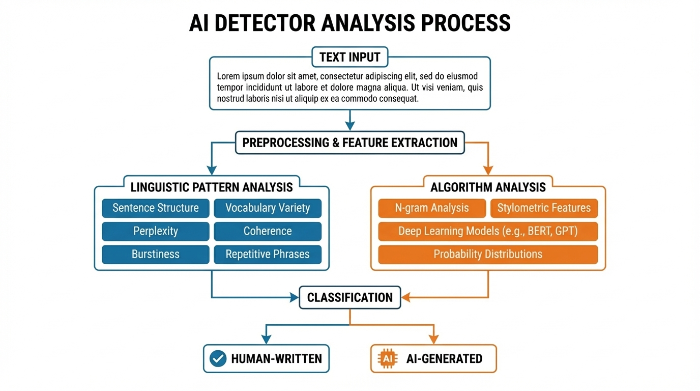
AI detectors are sophisticated tools engineered to differentiate between content generated by artificial intelligence and that written by humans. They utilize complex algorithms that examine linguistic patterns, stylistic characteristics, and various other data-driven metrics to assess the likelihood of a text being produced by AI.
It is a common misconception that an AI paper detector is the same as a plagiarism checker:
Traditional Plagiarism Tools: Scan for matching text in a database (e.g., "Copy-Paste").
AI Generator Detectors: Look for "statistical signatures." Even if the text is 100% unique and never published before, a detector might flag it if the sentence structures are too predictable.
How Accurate Are AI Detectors?
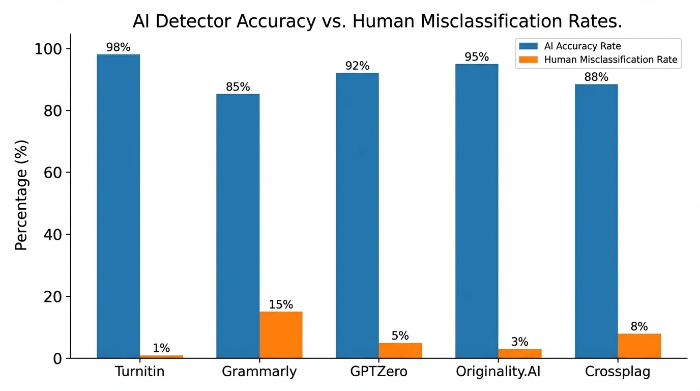
The accuracy of AI detectors is frequently questioned as users seek reliable means to distinguish between human and AI-generated text. For example, Turnitin claims an accuracy rate of around 90% for identifying AI-generated content; however, this percentage is subject to fluctuation based on the complexity and style of the submitted text. Likewise, Grammarly has ventured into the realm of AI detection and reports an accuracy rate close to 85%.
Although these seemingly high accuracy rates, misclassification remains a pervasive problem. A study conducted by the University of Southern California revealed that nearly 30% of human-written entries could be inaccurately flagged by AI detectors.
This data emphasizes the urgency for users—especially educators and students—to remain aware of the inherent weaknesses in relying solely on these tools.
As educational institutions increasingly adopt AI detection systems for anti-plagiarism measures, the risk of penalizing genuine student work becomes all too real, underscoring the necessity for ongoing advancements and robust training datasets in this field.
Real-World Implications of Inaccurate AI Detection
The impact of misclassification by AI detectors isn't hypothetical - it's happening in real academic settings and affecting students' lives. In 2025, Australian Catholic University publicly abandoned the use of Turnitin's AI Indicator after widespread “robo - cheating” accusations based solely on AI - detection scores caused distress and delays for many students. In about half of the cases involving alleged AI use, institutions found insufficient evidence once deeper review occurred, and those where the AI score was the only basis for suspicion were dismissed outright.
Similar real consequences have emerged elsewhere. In the U.S. at the University at Buffalo, a senior's final papers were flagged as likely AI - generated by Turnitin's detector despite being entirely student - written, affecting her academic standing and prompting a petition against the tool's use. Reports from student - and educator - focused forums describe scenarios where assignments written without AI were flagged at high AI percentages, triggering academic honesty investigations and undue stress - sometimes disproportionately affecting non - native English speakers and neurodivergent students.
AI detectors like Turnitin themselves acknowledge that false positives occur and stress that such tools should not be used as the sole evidence of misconduct. However, until verification practices improve, reliance on imperfect detection systems can jeopardize academic credit, delay graduations, and create environments of mistrust - underscoring the need for human review alongside automated checks.
Recommendations for Effectively Using AI Detectors
| Tool Name | Primary Use Case | Key Strength |
| Higher Education | Integrated into grading workflows; massive academic database. | |
| Teachers & Researchers | High sensitivity to "Burstiness" and "Perplexity." | |
| Enterprise & Multi-language | Exceptional at spotting paraphrased or "spun" AI content. | |
| Students & Professionals | Best for real-time checks during the editing process. | |
| Free/General Users | High accessibility for quick, high-level verification. |
For Teachers: Use the Turnitin AI detector for institutional rigor or GPTZero for detailed linguistic analysis.
For SEO & Marketing: Opt for Copyleaks or Writer.com to ensure your content isn't penalized by search engines.
For Quick Checks: ZeroGPT or Sapling provide fast, reliable snapshots of text authenticity.
Tricks and Tools to Bypass AI Detectors
As AI-generated content becomes more widespread, writers—whether students, professionals, or content creators—need strategies to ensure their work maintains a human touch while staying compliant with detection tools. Here are practical approaches:
Manual Editing and Personalization: Even if you start with AI-generated drafts, integrate personal experiences, insights, or local examples. These additions naturally break patterns that detectors flag as AI-like. For instance, including a short anecdote, a unique observation, or your reasoning process can make sentences more “bursty” and less uniform.
Diverse Phrasing and Structural Tweaks: Tools such as Quillbot or Sapling allow you to check phrasing or experiment with synonyms and sentence reordering. After running your text through a detector, identify flagged sections and rewrite them manually. Avoid wholesale rewording by AI—human-led changes preserve natural rhythm and readability.
Cross-Verification Across Platforms: Relying on a single AI checker can be misleading. For more accurate assessment, compare results from GPTZero, Copyleaks, and Originality.ai. If multiple tools flag a passage, review it carefully; if results diverge, prioritize human judgment and contextual nuance over raw AI scores.
Maintain an Audit Trail: Version histories in Google Docs, Microsoft OneDrive, or similar platforms serve as evidence of human involvement in writing. These records show incremental edits over time, reinforcing authenticity and helping to justify your work if questioned.
Intentional Sentence Variation: Break up long, uniform sentences and alternate sentence lengths. AI tends to produce evenly structured paragraphs, while human writing naturally varies. Combine this with precise word choices and idiomatic expressions to reduce the likelihood of false positives.
Use AI Detection as a Guide, Not a Judge: Consider detectors as advisory tools to identify sections that may appear formulaic or unnatural. Always apply your judgment to improve flow, clarity, and originality.
The Future of AI Detection
Grasping the capabilities and limitations of AI detectors is essential for informed writing practices moving forward. As we embrace AI technology, it is crucial to reflect critically and responsibly on its implementation. By sharing personal insights and experiences with AI detection accuracy, we can foster a constructive dialogue about navigating this continuously evolving landscape.